Aquaglide Deschutes 130 Kayak Review
Rating
Performance: 7
Size/Weight: 8
Durability: 7
Setup: 9
Value: 7
OVERALL: 7.6
Lightweight simplicity done right.
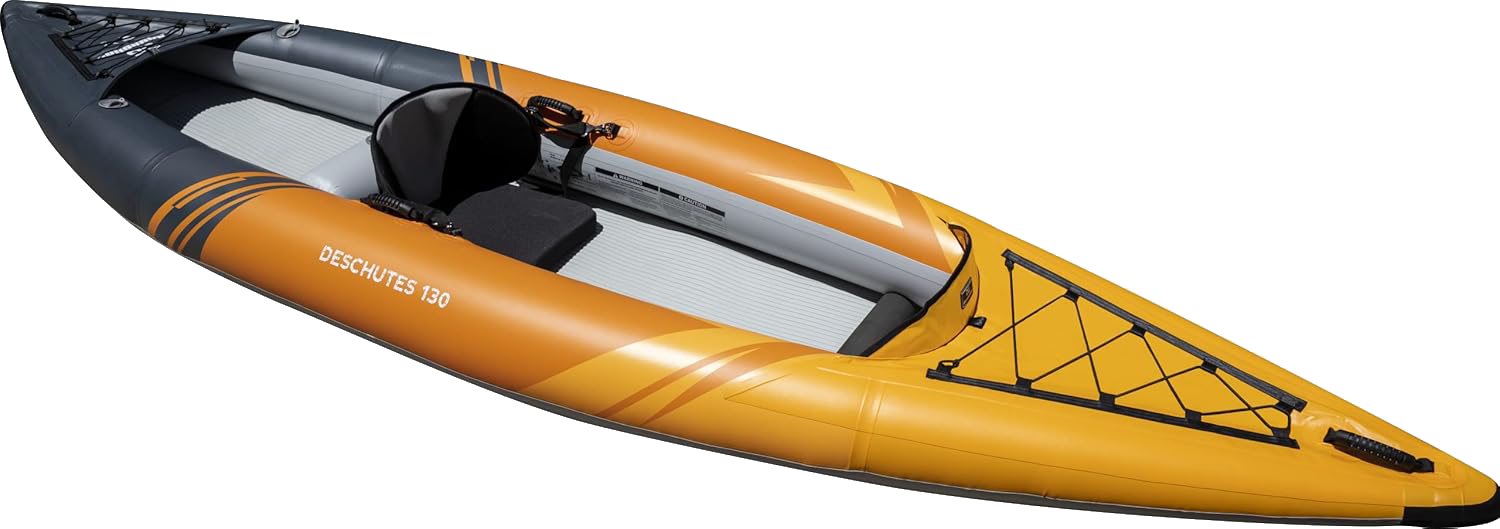
The Aquaglide Deschutes 130 takes a very different approach to inflatable kayaking. Instead of focusing purely on rigidity and speed, it prioritises portability, comfort and ease of use. The result is an incredibly lightweight touring kayak that’s easy to carry, quick to set up and genuinely relaxing to paddle, although it does sacrifice some tracking performance compared to more rigid rivals.
Comparison
Rank: #7
Open Size: Long and wide
Packed Size: Very compact
Weight: Very light
Capacity: High
Best For: Casual solo paddlers, those with apartments, travelers who want lightweight portability and stable comfort over speed.
Pros: Super light, extremely stable, comfortable, very easy to set up and dry quickly, packs into a roomy backpack for tiny storage.
Cons: Poor tracking in wind, tricky Halkey Roberts valve, slow, have to buy pump/paddles separately, wide hull can cause arm chafing.
Verdict: A ‘lifestyle’ kayak that trades speed and high-end performance for portability and laid-back comfort, making it perfect for calm waters but frustrating in wind or choppy conditions.
Skip ahead to First Impressions, Setup/Packdown, Paddling Experience, or the Final Verdict, check out how the Aquaglide Deschutes 130 compares to others in our list of the Top Ten 2 Person Inflatable Kayaks or see how we choose the best inflatable kayak.
Specs:
Open Size: 391×95cm
Packed Size: N/A
Weight: 10.1kg
Capacity: 181kg
Price: £359.95
First Impressions
The Aquaglide Deschutes 130 very light and compact. At around 10kg, it feels almost shockingly easy to carry compared to many inflatable kayaks in this category. A lot of touring inflatables quickly become awkward, heavy beasts once packed away, but the Deschutes is manageable. For apartment living, campervans, travelling, or anyone who simply doesn’t want to wrestle with a 20kg bag, this is a huge advantage. It doesn’t come with an inflatable drop-stitch floor, which we prefer, but this definitely keeps the weight down and actually still feels decently stiff even without it. The kayak has good back support, plenty of room and the open cockpit design makes getting in and out much easier than narrower touring inflatables.
The Deschutes focuses on lightweight portability and you can feel that in the construction. It’s not flimsy by any means, but it doesn’t quite have the same durable feel as some heavier-duty rivals. You’ll also notice pretty quickly that this isn’t the sharpest tracking inflatable out there. It lacks rigid moulded bow and stern sections, so it naturally wanders a bit more until you build momentum.
Setup/Packdown
Inflation is very straightforward once you understand the Halkey Roberts valves. First-time users sometimes struggle because the valves can seem confusing initially, especially if the pin position isn’t correct, so watch some tutorials or experiment a little with it before you head out. With a decent pump, it should take you roughly 5 to 15 minutes, depending on experience and whether they’re using a manual or electric pump.
The lack of a drop stitch floor becomes a huge advantage during pack down. There’s no extra floor insert to remove, dry and reinstall. You simply wipe it down, tip out any excess water, deflate it and roll it away; although we do prefer a drop-stich floor. Drying is also easier than average because of the simpler interior design and open layout.
We really like the included backpack, as it’s roomy enough that you don’t need military-grade folding precision to fit everything back inside. That may sound minor, but after a long paddle when you’re tired, wet and trying to avoid wrestling with zippers, it matters a lot. In saying that, the Deschutes 130 does need a proper deflation process if you want it to fit back into the bag cleanly. If air remains trapped inside, it quickly becomes bulky. Also, depending on where you’ve bought it from, you may need to separately purchase a pump, paddles and life jacket. Annoyingly, we did find the inflation adapter a little bit fiddly and poorly explained.
Paddling Experience
This is where the Deschutes becomes a very ‘depends what you want’ kind of kayak. If your goal is relaxed recreational paddling, easy exploration, slow touring, photography, fishing, camping trips, or simply enjoying being on the water, the Deschutes feels fantastic as it’s stable, forgiving, comfortable, and easy to spend hours in. The open design gives plenty of legroom, even for larger paddlers, and we noticed it feels roomy compared to narrower inflatables. It’s also very easy to enter and exit, which makes a big difference for older paddlers, beginners, or anyone who dislikes feeling trapped inside a cockpit.
On calm lakes, bays, rivers and sheltered coastal areas, the Deschutes 130 glides surprisingly well for such a lightweight inflatable. Once moving, it tracks better than you’d think, particularly with the skeg attached, but even with the skey, tracking is still one of its weaker points. Compared to kayaks like the Razor Kayaks R1 or Aqua Marina Steam, the Deschutes simply doesn’t hold a perfectly straight line as confidently. The softer hull shape and lack of rigid moulded bow and stern sections mean the front can sway side-to-side during the first few strokes before settling into rhythm.
Wind also affects it more than a hard-shell kayak or more performance-focused inflatables. Because it rides relatively high on the water, side winds and headwinds can push it around noticeably. If you like, you could add some weight to the front to improve tracking and balance.
In terms of speed, while the Deschutes is not slow for an inflatable, it’s also not particularly fast. If you’re paddling casually, it’s fine, but if your with others and they have better kayaks, you’ll have to work to keep up. We found the seats to be decently comfortable, too.
While the Deschutes seems tougher than its lightweight feel suggests, it doesn’t exactly inspire quite the same rugged confidence as heavier-duty inflatables with thicker materials and reinforced moulded ends.
Final Verdict
The Aquaglide Deschutes 130 succeeds because it understands what many inflatable kayak buyers actually want. Most people are not chasing maximum speed or elite-level tracking. They want something easy to store, easy to carry, quick to set up, comfortable to paddle and relaxing to use without turning every trip into a workout before even reaching the water, which is where the Deschutes shines. It especially suits casual touring, travel, camping, apartment living, and recreational paddling where convenience matters just as much as on-water performance.
At the same time, it’s important to be realistic about its limitations. It does not track as sharply as performance-oriented inflatables like the Razor Kayaks R1. It can wander in wind, especially before building momentum. The materials and seams, while perfectly fine for most recreational use, don’t feel quite as rugged as some competitors. If you approach it as a lightweight adventure kayak designed around simplicity and enjoyment rather than outright performance, the Deschutes 130 becomes incredibly appealing.
Want to see how the Aquaglide Deschutes 130 compares to other kayaks we tested? Head over to our list of the Top Ten Inflatable Kayaks.
Water & Outdoors reviews are written by our staff writers, who combined have over fifty years of experience on the water and outdoors. We may earn commissions if you choose to buy through a link you’ve clicked on our website, however this does not influence our reviews. For more information, please see our Editorial Policies.